Tuesday, April 2, 2019

Big implies Little


Yes, there is also a Small Wild Goose Pagoda.

Small Wild Goose Pagoda was a lot less crowded than it’s big brother (see previous post). There’s a little craft village with resident artists showcasing some of the regional specialities such as leatherwork, calligraphy, paper cutting, tea arts and jade carving, all clustered around a courtyard with a pond and trees.


I was offered an impromptu tea-tasting and I got to sample some old Puér, a local Dragon Well, and several other teas. The man serving was happy to cut off extra PuEr from a round cake wrapped in rice-paper, which he added to my water bottle with fresh hot water.


The museum beside the Pagoda was excellent, in a light, modern building and far less busy. Thee was no café, but in the little shop, the girls were eating their bowls of noodles, and when I mimed that the lovely smell was making me feel hungry, they insisted on me taking a mooncake. I took it away gracefully even though I didn’t think I’d be able to eat it, but it was packed with walnuts and sesame seeds, only a little bean paste and hardly any sugar. The best mooncake I have ever had, washed down with the old Puér.


The Bell Tower, beside the Pagoda


A lovely museum building - The Pagoda is in fact part of the
Xi’an Museum


Lovely grounds around the Pagoda


I had many such friendly interactions despite almost never coming across anyone who spoke any English. On a particularly slow local bus I took out my book, and caused a great hilarity with the other passengers. The woman beside me couldn’t stop pointing at it and telling the rest of the bus how strange it was that a gweilo would be reading a BOOK. I thought she was saying something along the lines of she doesn’t even have a kindle, isn’t it quaint? How strange and backward the red devils are. Hysterical really. I even used real money, where everyone else was paying for everything including bus fares by waving their phone at a scanner. 

Which brings me to the subject of phones, especially the lack of headphones. If they’re not having robust conversations in ear-splitting voices and in (to my ear) abusive, aggressive tones, people were watching videos or playing games or something. So, on the train or bus or any other place, there are multiple tinny soundtracks filling up the space – public space, folks! And because sometimes they were seated right beside me I could see what some of these folk were watching – a young girl spent her commute scrolling through ads for makeup and watching videos of women unpacking postal packages and admiring the tubes and bottles inside, while the young man with the seat beside mine on the bullet train watched videos of how to undo bits of machinery with various wrenches and spanners – both with mindless endless soundtracks.


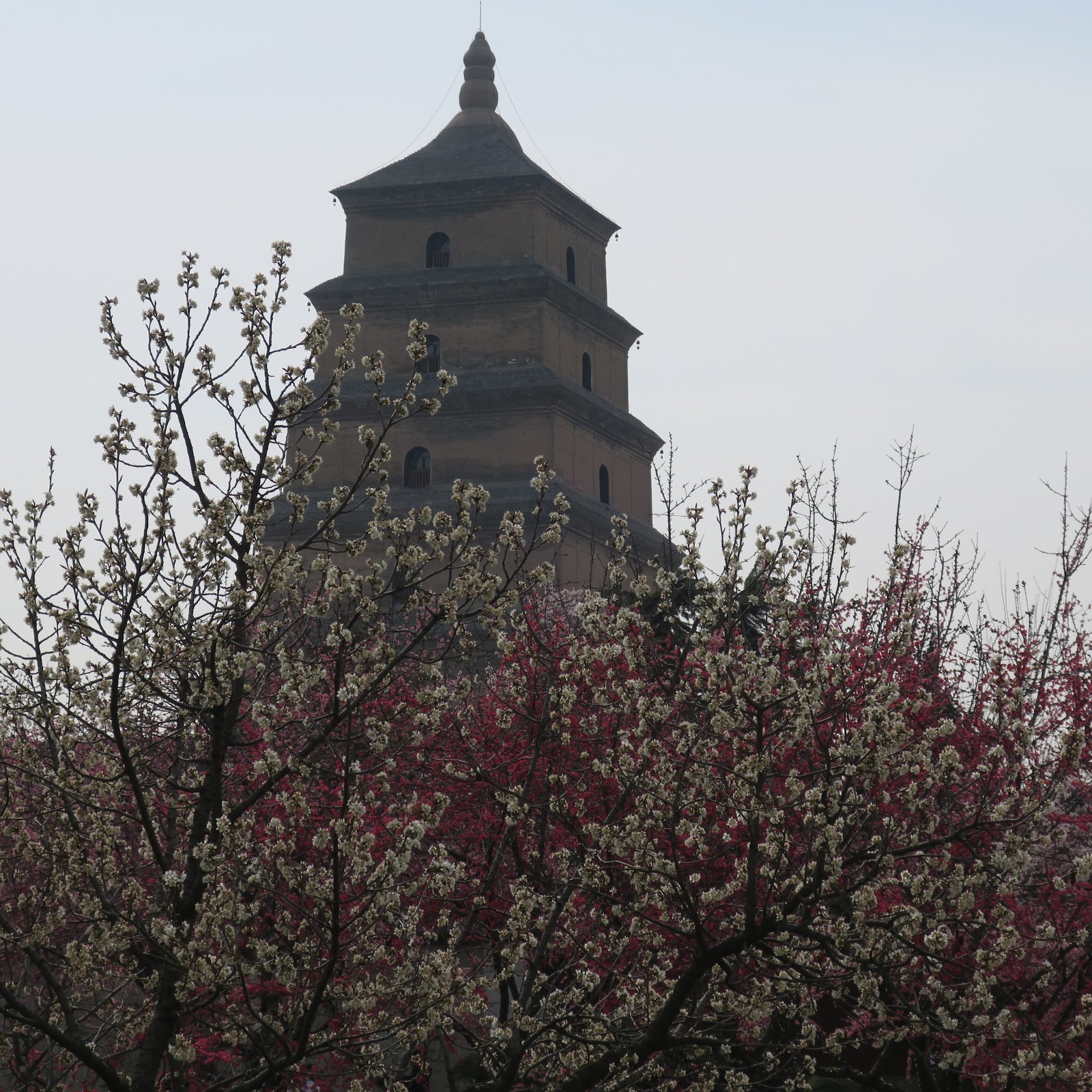
Big Wild Goose Pagoda, Xi'an


It is library actually - a beautifully-named library. Big Wild Goose Pagoda is Xi’an’s most sacred monument. The original pagoda was built in the Tang Dynasty (618-907) for the study of Buddhist scriptures. An intrepid Buddhist monk called Xuanzang travelled across India for 18 years and returned with a precious collection of Sanskrit scriptures and Buddhist sacred texts, and the pagoda was built to house those treasures. 

Most of the original 5-story earth structure has gone, but the current 7-story pagoda was built in the same style using traditional building methods. Even though it is basically an empty shell, it stands out on the skyline and is beautifully lit up at night. Maybe if was renamed as Big Wild Goose Library Pagoda that would help the cause of libraries everywhere.

Knowledge is not always venerated, and in 1966, Red Guards burnt the pagoda’s scriptures, silk wall hangings and other relics in a bonfire that raged all night. But that tragic destruction has largely been forgotten by the crowds that flock to the Pagoda complex.

The northern square of the Pagoda boasts the biggest sound and light extravaganza in the world. Every night there is a Fountain and Music Show featuring synchronised colour, water and sound effects.
North Plaza and Big Wild Goose Pagoda in the distance.
Statue is of a large book that symbolically tells of the richness
of the Tang Empire 

And to the south is the Tang Paradise, a vast adventure park themed to show off the cultural richness of the Tang Empire.

I visited the Pagoda on a Sunday, when the spacious modern plazas around the monument were packed with families.  I skipped the theme park and instead went to the nearby Shaanxi History Museum. Locals get in free, and there were queues for hundreds of metres in both directions, which should have put me off. But I was only in Xian for a couple of days, and I was here now, so I skipped the queue and bought my ticket so I could go straight in (more or less, there was another queue for the ubiquitous security check). Just me and 4,000 other people. 


It’s a fantastic museum but negotiating the crowds and the stuffiness meant that after a couple of hours I felt totally exhausted.


A big hot-stone bowl of bibimbap later, and fully restored, I walked to the famous Muslim street. More crowds, more food temptations, more noise. 


Roujiami buns 

One that should take off in Australia - the fruit salad bar. You take a container (plastic) and fill it with the
fruit of your choice, it's weighed at the end and you pay accordingly

I tried roujiami, the signature dish of this part of China. The smell of the huge vats of steaming meaty stuff was less than appealing, but the bread that was being kneaded, flattened and tossed onto the hotplate looked pretty good. It’s a version of something in between a pie and a hamburger - the flat bread is split and filled with fragrantly-spiced meaty stew stuff. It was greasy, possibly mutton-y, had lots of soft gristly bits and gravy, and the roll was both soft and flaky, a cross between bread and pastry, and the whole was – absolutely delicious. Take noted, pie entrepreneurs, this will become a Thing. Pig totters, maybe not so much.
On the walk from the Pagoda to the Muslim Street - this flower wall. There were beds and
installations like this all the way along the 35km route to the Terracotta Warriors, and in so many
places around the city. I cannot even begin to imagine the size of the nurseries that
produce this many plants, let alone the labour force required to put them in place.

Hire bikes - everywhere, all across the city. 


Tuesday, March 26, 2019

Xi'an, China


My flight with Sichuan Air arrived at 1.30am. I was the only white foreigner on the plane and over the next 6 days in Xi'an I saw hardly any English-speaking tourists, even at the key tourist sights.

The airport is about 35 km out of the city. What struck me as we flew over miles and miles of city tracked by seemingly endless grids of brightly lit wide highways is the sheer scale of development that has gone on here over the last few decades. The plane taxied for ages across tarmac past several terminal buildings and hundreds of planes belong to a myriad of different carriers. Heading into the city along one of those highways, I kept thinking I could see hills on the horizon until I worked out that I was seeing was the lights twinkling at the top of scattered forests of multi-storey towers. Seemed like 12-lane roads all the way, roads lined all the way with street lights decorated with red lights in arrangements resembling Chines lanterns or tassels.


The total state power bill must be beyond astronomical. They must have to stagger the turning on of street lights in the evenings to avoid a massive fuse blowout. I saw quite a few old roof-mounted solar water-heater panels, but no other evidence of solar, yet official figures say 30% of China’s power now comes from solar sources. On the other hand, all but a very few of the motor-bikes and other two and three wheeled vehicles were electric (blessedly quiet, but they sneak up behind you on the footpaths). Most of the buses were electric too. I didn’t see any public charging stations, so I’m not sure how that happens – maybe people take the batteries home with them for recharging? Just one of the many puzzling things I saw. The faster the rest of the world catches up with quiet vehicles the better, as far as I’m concerned.

Xi'an is one of the oldest cities in China and it’s right in the middle. As every description of the place says, it is the Eastern gateway of the Silk Road. So it has always been an international hub, welcoming traders and diplomats from afar, and now welcoming tourists with equanimity, if not exactly warmth. The wealth that grew from trade, especially trade in silk (and no doubt, weapons) for horses, was such that successive Emperors (73 of them!) have reigned from here. As a wealthy centre from which power has radiated out in all directions it has been hotly contested. Ironic, no, that the old name for the city is Changán, meaning Perpetual Peace.
Hence the reason the old part of the city is surrounded by 14 km of walls dotted with watchtowers and defended with massive double-jeopardy style gates and surrounded by a wide moat. I did the standard tourist thing and rented a bike to judder my way around the whole wide wall on the cobblestones. It was surprisingly peaceful. This was one of the only times that I saw other gui lo (red devils) in Xian.
East Gate 

The replica watchtowers along the wall now house spotlessly clean toilets
Just for reference, this is NOT where I was staying, but it was the foyer. The Xian Boutique Aparthotel is on the 20th floor of a very large block of apartments with a shopping centre on the lower floors. There's quite a bit of night-life in the area around. My hotel is run by Any who has over 20 years experience as a guide in Xian and speaks perfect English. He has lots of helpful advice to suit every budget and his partner Steve, who is English, was also extremely helpful. Recommended!


The city has a couple of other highly-visible historical symbols, like the beautifully-lit pagoda I could see from my 20th floor hotel room but overwhelmingly, Xian has a thoroughly modern pulse. With a population of somewhere upwards of 12 million it is a vast, exciting, noisy city, growing rapidly if the number of cranes is anything to go by. It makes sense that in a place that has so well fortified in the past, military industries would be important, and modern Xi'an is now a centre for aerospace and military technologies, as well as education and research. There are 56 universities. Artificial Intelligence, nanotechnologies and robotics are among the growth industries. It is probably one of the safest places in the world to be a tourist.
Construction and tourism. Millions of tourists - in 2016, 150 million of them, with 80% being domestic visitors. The discovery of the terracotta warriors in 1974 set off a tide of rubberneckers. Xi'an is also the place where the lunar new year was first celebrated, so it is a special place for Chinese visitors during the holiday period. The local authorities clearly are doing their best to capitalise on that reputation, with huge installations to celebrate the Year of the Pig in many of the public spaces.


Around the city, every park and open space seemed to be undergoing renovation and renewal, including adding musical fountains, light installations, themed pavilions, green walls, seasonal plant beds and more. I went to Lian Hu Park in the middle of the old city which was supposed to be a local oasis where you can enjoy lots of spring blossoms and peaceful lotus ponds. I negotiated my way around an almost-completed huge indoor roller-skating rink to find that most of the park was a building site and the ‘lake’ completely drained. Yet in the bits that could be walked, it was all happening. Ballroom dancing. Individuals doing tai chi. Old men with birds in cages. A cluster doing some sort of folk dancing or salsa maybe, some dressed in costume – Slavic? Flamenco? Middle Eastern? Hard to tell with the scratchy amplification and opposing tinny notes from a wee orchestra of old men sawing at mysterious instruments and a woman with a microphone screeching out some extraordinary Chinese opera song that to my ear sounded unnaturally discordant. That lot were drawing a good crowd of old folk though. And just beside them, a younger group being loudly directed in Step or some other sort of synchronised exercising to bouncy music. In between, kiddies on wee bikes running amok in the early spring haze that could almost be called sunshine.

Everywhere I went was amazingly clean. I’m certain there are whole armies of cleaners, sweepers and rubbish collectors employed to keep it like this. Minimal graffiti, tidy pavements, discrete rubbish bins. It seems like western cities could learn lessons here, surely a street sweeping or butt-picking job would be preferable to begging for many folk?

Butts. Smoking. It’s banned in the entire City Wall precinct but that only means that the toilets reek of sneaky puffing. In the apartment block where my hotel was there were No Smoking signs everywhere and yet the smell of smoke lingered constantly. There were ashtrays in the rooms and trays of butts at the end of the corridors. Men lighting up as they got out of the lift, before they even made out of the lobby. Men. Now I think about it, I can’t remember seeing any women smoking. It was almost a shock at the airport in Madrid to see young women lighting up.


Monday, March 25, 2019

An Army in Clay


The mighty army of terracotta warriors and horses is one of the most popular tourist attractions in China and one of the reasons for my 6-day stopover in Xi an. The Terracotta Army experience is usually described as an on-site museum built over the top of several excavated pits. It has some elements that are museum-like, but within a whole industry that has mushroomed to catch the tourist dollar – oops, I mean, to cater for the millions of visitors who come see the birthplace of civilisation and power of the Middle Kingdom. 

Since the site was listed as a world cultural heritage site by UNESCO in 1987, and cleverly billed by the Chinese as the Eighth Wonder of the World, every imaginable associated money-making opportunity has been tapped, with businesses small and large claiming whatever share of the pie they can get. The museum part is just a bit dated now – the hanger over the warriors was built back in the 80s. It does a good job of giving thousands of people a decent view of what has been excavated. 

It also is effective in giving the sense that there is much more yet to be revealed. As someone else said, it looks like the archaeologists just went to lunch and decided not to come back. You are left with a lingering feeling that much here is still hidden and unexplained. 

I caught a local bus to the tomb site from the vast plaza in front of the train station in town. A couple of girls with megaphones hustled people to rush on board, as if there was never going to be another bus so you better grab this one right now and be quick about it. Ignore the sight of another 20 buses along the line. Megaphones? Utterly redundant. These girls have voices that could bring down walls. Voices that would herd ducks into line at 500 metres. My bus pulled out less than full, with one of the girls hanging out the door. We proceeded to crawl along the road out of town as she vigorously and loudly exhorted anyone standing nearby, doing her best to fill the empty seats. And it worked, more people got on, the bus filled up as passed hotels and roadside souvenir shops. And so we made our way.

The approach and entry to the site is pretty well organised on a scale appropriate for the modern-day hordes. There are not too many touts, just the tour guides really. It is dismaying to have to wend your way past McDonald’s and KFC and hundreds of other food outlets and tacky souvenir shops lining a huge shopping plaza just to get back to the bus stop, but that’s how it goes. It becomes hard to remember that here is the mausoleum of one of China’s most hedonistic, brutal and cruel Emperors, and a relic of a short-lived and violent empire that nevertheless is credited with joining the warring states to form a country that is now modern-day China. Lessons from the past are not given much thought here.


Then a walk across a vast car park, filing in orderly lines through security, another walk to the lines in front of a long row of ticket counters and finally into, what, a park? Follow all the other folk along pleasant paths for another 10 minutes to get to the main site. This part of the experience is nicely done, with lots of small paths through groves of trees and open park.

You probably know that there are over 2,000 terracotta figures on display in a structure a bit like a huge gym, with a couple of smaller pits nearby that have been other remains in them. State-of-the-art museum this is not, but the main hanger over Pit 1 was built for crowds and does a pretty good job of guaranteeing that everyone gets to see the exhibits first-hand as well as getting a sense of the overall scale of the enormous pit. I kept reading that the terracotta figures are life-sized, but I reckon they are least 15% larger-than-life, especially given that people were on average smaller back then.


I saved Pit One, where the army stands, for last. I lingered through the exhibits in the other two buildings – that is, in comparison to the tour groups, all with their headphones on, being ushered along at pace by flag-carrying guides speaking into microphones that seemed to miraculously swallow up all voice sounds. The English signage is scanty, and I saw no English-speaking groups to tack onto. Maybe it would have been better to have a guide.

Not sure what this says about me, but I was at least as interested in watching the crowds as I was in what was on display. Maybe the scale of the exhibits is hard to get your head around. I really enjoyed getting up close to the individual figures on display in the Exhibition Hall on site and in a couple of the museums in Xian that I visited later but even then I was constantly distracted. The act of viewing and the behaviour of viewers intrigued me as much as the objects being viewed. 

When I wasn’t diving in between phones for a spot at the front of the crowd where I could see what we were here to see, there was plenty of distraction in watching people around me posing for selfies. Often I 'd get my first view through someone else's eyes - just by looking at their phone screens as they zoomed and panned and scanned and snapped. For many people it seems to be I came, I took photo, I went. Maybe actual seeing has time-shifted – then again, do people actually go back and look at the images they collect? 

But back to the Terracotta Army. Pit 1 is believed to contain at least 6000 warriors with only 2000 on display plus some horses, all facing east and ready for battle. In front front there are rows of archers, followed by soldiers, who would have held spears, swords, dagger-axes and other weapons, believed to have been mostly looted at various times. It’s impressive no doubt, but I found it a hard to take in.


There's question of what we do and don’t see at this tomb site. The two bronze chariots on display at the site are clearly signed as replicas. I read that the tomb contained 50 or 80 chariots which raises the question of where they are. Or has the timber simply disintegrated, in which case how do they know how many there were?


Any lucrative tourist activity attracts scams and even though this a UNESCO World Heritage listed site, I can’t help but be cynical. A quick check on Amazon before I got here (site blocked within China) shows I could buy my own full-size authentic reproduction warrior for US$700.

Originally the figures in the army were painted bright colours, which flaked off when they were uncovered. It is interesting that all the replicas for sale are clay-coloured. I didn’t see any painted models for sale, which is too bad because the original greens, reds, blues and purples must have looked pretty good.

Reproductions are a multi-million dollar industry, and my google search revealed there at least 30 factories around the site that turn out warrior replicas, some of which are made pretty much the same way and out of the same materials as the originals.

Thousands of visitors who paid to see some of the warriors in a museum in Hamburg in 2015 only found out later that they were fakes. If a German museum can pull that off, what else is possible?
Just saying I’m taking it all with a grain of salt. The actual tomb where Emperor Qin was buried has never been opened and the usual story is that it is highly toxic, due to him having ordered that it include a river of mercury. Or is that excavations are on hold to keep the remains sealed until archaeologists are confident that their method won’t damage any of the contents? I have read both explanations, and perhaps both are true.

Another good museum story – in 2017 a Philadelphia Museum exhibited 10 of the warriors loaned by the Chinese government. You know how staff Christmas parties can go? So someone wandered into the exhibition space that had been left unlocked, and he broke off and pocketed the thumb of one of the guys, no doubt after taking a few selfies. No one even noticed for ages. Imagine how much compensation that would have been worth!

A few notes on the Army for those interested. It is 2,000 years old and was made to stand guard over the tomb of China's first Emperor, Qin Shi Huang.

Archaeologists believe Qin Shi Huang expected his rule to continue in death as it had in life. To make sure this would happen, he needed his mausoleum to be defended. He was a ruthless despotic ruler who made many enemies. First Emperor was only 13 when he first came to the throne and it is believed that one of his first actions was to order the creation of an army that would protect him in the afterlife.

The tomb was built over a period of 40 years by an estimated 700,000 labourers. The warriors and their horses are clay figures but many real people were buried in the same area. Archaeologists have discovered mass graves with the remains of people who were probably craftsmen and laborers. Some of them seem to be convicted criminals who died in chains.
Many bronze items have also been unearthed around the tomb site. Geese, ducks, cranes, swans, horses and chariots have been found.

First Emperor waged wars that united many kingdoms into one vast empire. He brought in a single system of coinage, standardised writing and the system of weights and measures, and gathered enormous wealth. He is the one who ordered construction of the Great Wall for protection against attacks from the north.

All these wars, repression, massive taxes and construction projects brought misery and death on a massive scale. The Warring States had in about 40 million people at the end of the Zhou Dynasty period when Qin Shi Huang came to the throne, but at the end of the Qin Empire, there were only 18 million people left in the region.

The Qin Dynasty only lasted for 14 years, the shortest empire in China’s history. Such was First Emperor’s zeal for restricting access to knowledge from the past, that much of the literature and art works of previous reigns was destroyed. At one time he ordered that more than 460 Confucian scholars to be buried alive for possessing forbidden books. 

An afterlife surrounded by instruments of war, death and destruction doesn't seem like much to aspire to. Some remains of figures of acrobats, dancers and musicians have been uncovered nearby the warriors but I think I prefer the picture of heaven depicted in the Koran as gardens of pleasure fed by rivers, and couches adorned in silk. And yet, who knows what decadent luxuries mat come to light when the Emperor's tomb is eventually opened? 


Friday, March 8, 2019

Big Market


It’s really called Wororot Market, but it’s known just as Big Market. This is one of the less touristy markets in the central area of Chiang Mai, between the Old Town and the river. Wororot is one of two 3-storey market buildings here. There’s a fruit and flower market in the evening, but I missed that. 

Food businesses dominate, but basically you can probably find just about anything for sale, from religious artifacts to fishing gear. Cosmetics and pharmacy products and Chinese remedies, clothing and footwear, household paraphernalia including handmade copper pots, dried fruit and leaves, betel nuts, jewelry, stationery…

The lanes and alleys around the market buildings are lined with shops and roadside stalls. Quite a few sell hill tribe textiles and handicrafts. You have to wonder how much is still hand-made, though. One the other hand it's good to see contemporary designers doing new takes using traditional crafts, patterns and styles. 


There are lots of fabric and haberdashery shops. This was the main attraction for me, and I spent half a day wandering around. One of the reviews on Trip Advisor said to wear shoes rather than sandals because there quite a few rats. Like what are they going to do, nibble your toes?  I didn’t see any, even in the basement food court where I perched on a plastic stool to eat vegetarian omelette with rice and red curry.

The local English-language monthly magazine says about this market “You’ll be tempted by the unexpected”. I wasn’t so tempted by strips of buffalo hide and hair, as unexpected as they were; but what are they FOR? I think people actually buy them to chew on the leathery flesh. Mmmmm.


Stacks and stacks of the traditional pleated indigo cotton skirts with embroidered bands

Indigo-dyed fabrics, finely stitched, like sashiko

Sashiko stitching all over - beautiful, can it be hand work? 

Beautiful embroidery


Walking the streets


I’m fascinated by the life on the streets in Chiang Mai. Despite the difficulties of actually walking around town, there’s a whole economy going on along these roads and lanes. So what makes walking difficult? Well, heat for one thing. At this time of year the mornings are cool but still after 15 minutes or so I’m wiping sweat off my face. By noon the only thing to do is hang out somewhere with aircon. Then there’s the smog. This is the time of year that farmers burn off sugar cane, ahead of the wet season. One report in the Bangkok Post said that Chiang Mai was up in the top three worst towns in the world for air quality. And there are the millions of motorbikes and scooters. Like millions of them. Plus all the rest of the traffic, and the nasty fumes those motorised trishaws put out is something else. 


Efficient public transport, but oh, those fumes, and the noise
Foot paths are mostly non-existent, so most of the time you are walking in the road, around parked vehicles and roadside food stalls. Some of the bigger roads do have sidewalks, but they are certainly not designed for walking. You are constantly dodging wobbly slabs over monsoon drains, ducking around tree trunks, squeezing between parked vehicles and stepping up or down off the kerb. 

As if that’s not unfriendly enough, there are elections coming up later this month, and the roadsides are flush with huge signs promoting the candidates. It’s hard to know how many parties are contesting, but probably over 40. The exiled past Prime Minister, Thaksin Shinawatra, is a local and has an extremely strong support base here still. I can’t work out if the signs are for individual candidates or parties, but they are all of uniform size, and they are hung on power poles so they come down to about shoulder height. They take up just about the space along the roadside, forcing me onto the road itself.

Chiang Mai is very urbanised, but still cross-crossed by quieter small streets that still feel almost rural. In the past there would have been local villages clustered around the city to provide labour and produce for the elites. Many of these supported specialised artisan communities. There was a silver village and an umbrella village. Crafts like pottery and lacquerware were concentrated in particular places where skills were passed down through generations. The Old Town caters for tourists and is awash with bars, trendy cafes, massage parlours and spas, guesthouses and tour operators. But the suburban streets are where the rest of the commercial business takes place,  a diverse and thriving microeconomy in the midst of residential neighbourhoods. 


In between dodging the motorbikes I was fascinated by the variety of small businesses operating along the smaller streets. In some roads, just about every house also has some sort of business going on. There are services to the neighbourhood – childcare, coin-in-slot washing machines, hairdressers, fast food stalls, tattooists, tiny shops selling drinks and snacks. I spotted a pet-grooming service where a large long-haired golden cat was being tenderly blow-dried. Bike repair garages, barbers, laundries, bars, web design, electrical repairs, photocopying and printing, tailors – and much more. How come we abandoned this opportunity to combine lifestyle and work for anonymous shopping centres and a 9 to 5 existence?