Saturday, March 2, 2019

Exploring Chiang Mai


Chiang Mai - a destination for dental work that would break the bank if you had it done at home, partying backpackers, home to retirees seeking a cheaper life, residential meditation courses, aging western men reliving fatherhood with their much younger Thai wives, digital nomads, trekkers; some of the things I associated with Chiangmai.

And some things I have learned in my wanders since arriving a week ago.

Yes there’s a lot of traffic on the main roads, but the small alleys that criss-cross town are quiet, dusty village lanes and easy to navigate. Plus they sustain thriving neighbourhood micro-economies with many homes also functioning not just as guesthouses, cafes and bars, but also a whole range of small enterprises that cater to the local population; from pet grooming to laundry services, haircuts to scooter repair, take-away food. 


The Old Town was laid out at the end of the thirteenth century. It is very walkable, covering one square mile - almost, but not quite a square, and almost perfectly aligned to the north and south. The City walls no longer exist but the entire Old Town is still surrounded by a moat. There are remains of ancient corner ramparts


There used to be five gates, one in the centre of each wall and an extra one on the south side that was for taking out the dead. Each of these Gates is flanked by reconstructed sections of wall. On Friday a pair of tourists were arrested when they were caught sitting on the wall drinking. 

At this time of year the hourly air pollution index warns constantly that levels are Unhealthy (or look to the horizon – if you can’t see the mountains, pull on a face mask). Today it is around 122 (Unhealthy for those who are Sensitive) and I can just see the hills. A reading of 50 is considered Safe. The other day it was 165. So what has happened? The government ban of burning off came into effect on Saturday. 

It gets hot in the afternoons but nights and mornings are cool and the air is dry. The temperature range today is 17 to 37. I have found a nearby guesthouse that offers use of the pool for a small daily fee. 

Chiang Mai has more than 300 Buddhist temples, and a population of .5 million. 


Five of the temples in the Old Town host drop-in Monk Chat programs, where foreigners get paired up with a young monk and get to ask any questions at all. So why do all the monks have mobile phones and how do they afford them? 

It is the home of Thaksin Shinawatra, the exiled former Prime Minister. With elections coming up in a month, it's pretty hard to walk along any of the busy roads for the proliferation of huge billboards.


 There are 14 National Parks in Chiang Mai region. Nearby Doi Inthanon, the highest peak in Thailand, is actually part of the Himalayas.

There are at least 10 Co-Working spaces around the town and most cafes have fast free wifi. Nimman, the area around Chiang Mai University, is sprouting wine bars, tea houses, galleries and boutiques, spas and salad bars, IT start-up spaces, craft shops, condos and restaurants.  

There's a design resource centre, library and workspace, TCDC, that was set up by the government to support creative industries. It works on a membership model, a bit like a gym, only it offers knowledge and tools to turn original, innovative ideas into real economic returns. 

There are massage parlours everywhere, but the Lila parlours offer something extra – your chance to contribute to a rehabilitation program run by Thai Correctional Services. The well-trained masseuses are ex-inmates. I enjoyed a relaxing and restorative one-hour foot massage for around AUD12 and my masseuse didn't look at all like a drug-dealer or murderer. Other types of massage are readily available, if the sign doesn't actually spell it out the girls outside in make-up, hot pants and high heels are a bit of a give-away.


Tuesday, February 12, 2019

An afternoon stroll out of town

At the temple in the main street of Ubud another festival is taking place and the traffic is crazier than usual. Late afternoon, a thunder storm brewing in the distance, and the rice paddies are calling. 


So this is a short stroll along Jalan Kajeng, which leads, as the sign says, to the rice fields. At this end the street is busy with motorbikes.


The street is paved with signed concrete blocks and decorated with inlaid river stones. Lots are signed by individuals, families and businesses, and they mostly date from around 2002. How many of those who contributed still walk over their signatures?


At the start of the street there are the usual businesses - guest houses behind walls with decorated gateways, spas, shops selling arts and crafts, places for cooking classes and painting lessons. 


The base for Ubud Botany Interactive looks a bit derelict, and the Ubud Sari Health resort doesn't look all that well either - but in this climate, moss grows on everything. I'm sure it is lovely once past the entry. 


My favorite shop of this short street is Threads of Life. It is part shop, part gallery, and part textile museum; and they also offer classes and workshops. (These seem to be for groups. Anyone keen on a textile tour?) As well as textiles from different regions of Indonesia, there are examples of traditional basket weaving and other crafts. They support women in the more isolated and remote areas of the islands, encouraging cooperatives that allow them to pursue their traditions and earn an income at the same time, and they help to support highly skilled artisans to pass on and preserve their knowledge. 

After this, my path leaves the street, though unfortunately the passing motorbikes only thin out marginally. 


The path follows the irrigation channels between the fields. Peace descends and the air is fresher. Here and there, fallow fields are being cleared of the water weeds in preparation for the next planting. These fields are a feat of engineering that have endured for centuries and are still managed in the same way as they have been through the decades. Its a cooperative system that is defined by watershed rather than by politics. I'm intrigued by the strength of the walls that define each small field. How did they work out exactly how wide they need to be to maintain strength through wet and dry seasons? 
a resilient system of bottom-up management that both increases and equalizes harvests (Adaptive self-organisation of Bali's rice fields). 
- in Bali, water is regarded as a public good, the gift of the Goddess of the Lakes.   

Preparing for the women to come and plant the next crop of rice. Some farmers do the job by hand, pulling out armfuls of weeds at a time and sinking them deep into the mud. Others have a machine that does the same thing. 

My destination - a restaurant surrounded by the paddy fields. So what'll it be for early dinner? Check out the meal at the end of this post. Meantime those storm clouds are looking interesting. Utter peacefulness and timelessness.  Distant thunder is the only sound.  


 The expat hunger to live in a villa in the countryside is eating into the arable land, but who wouldn't want to live in a location like this?


Nasi campur with lots of herbs. Organic red rice. Of course - this is Ubud. 

Monday, February 11, 2019

A stroll along 'my' street - Jalan Gautama, Ubud

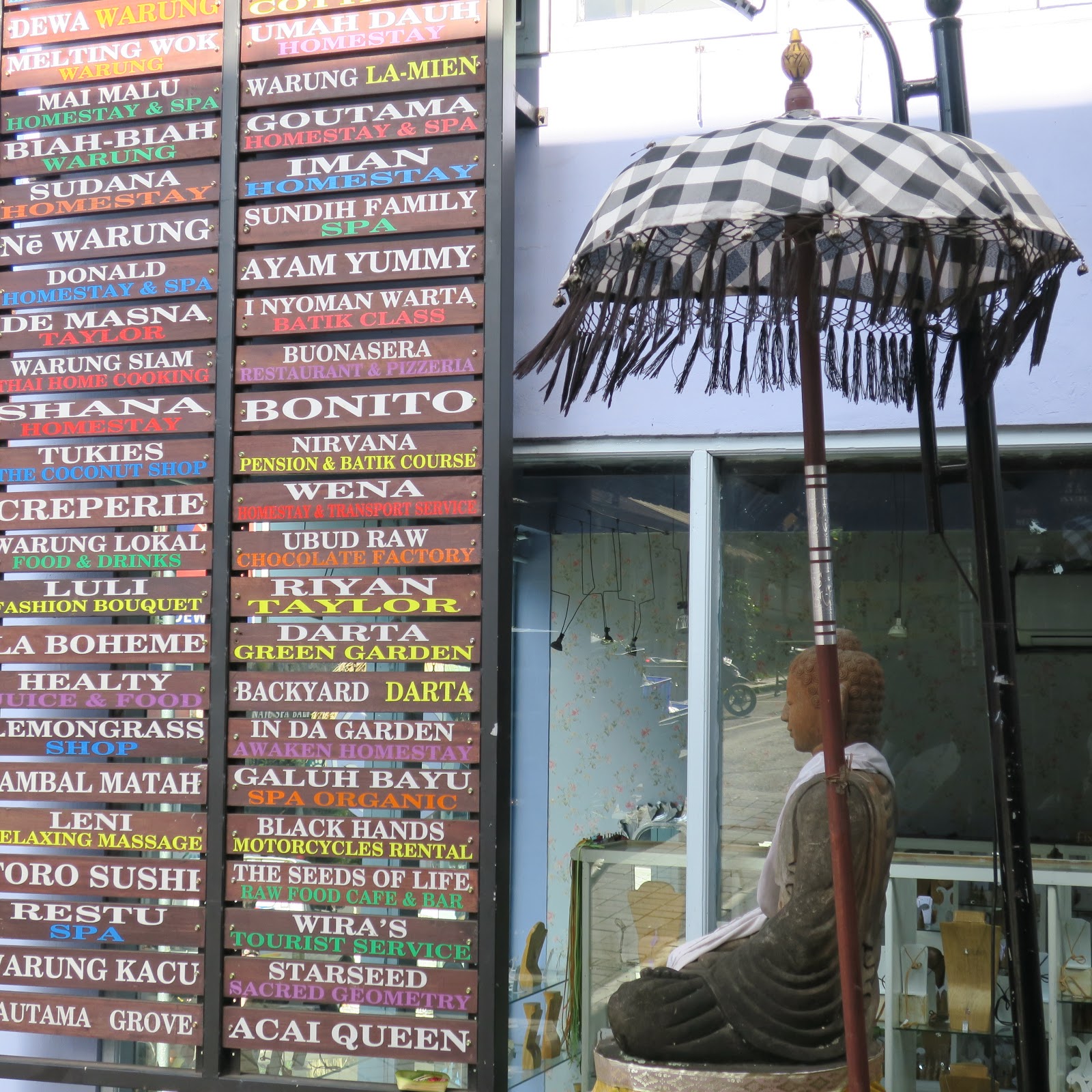
After a few days in Ubud I'm starting to see more. I'm staying in a homestay in Jalan Gootama. It's a small street which thankfully is closed to cars in the evenings, but busy with scooters and motorbikes all the time. It is a street that rewards a slower perambulation.

This is a very awakened street and I'm blessed to have chosen an awakened place to stay (more on the accommodation at In Da Garden later).

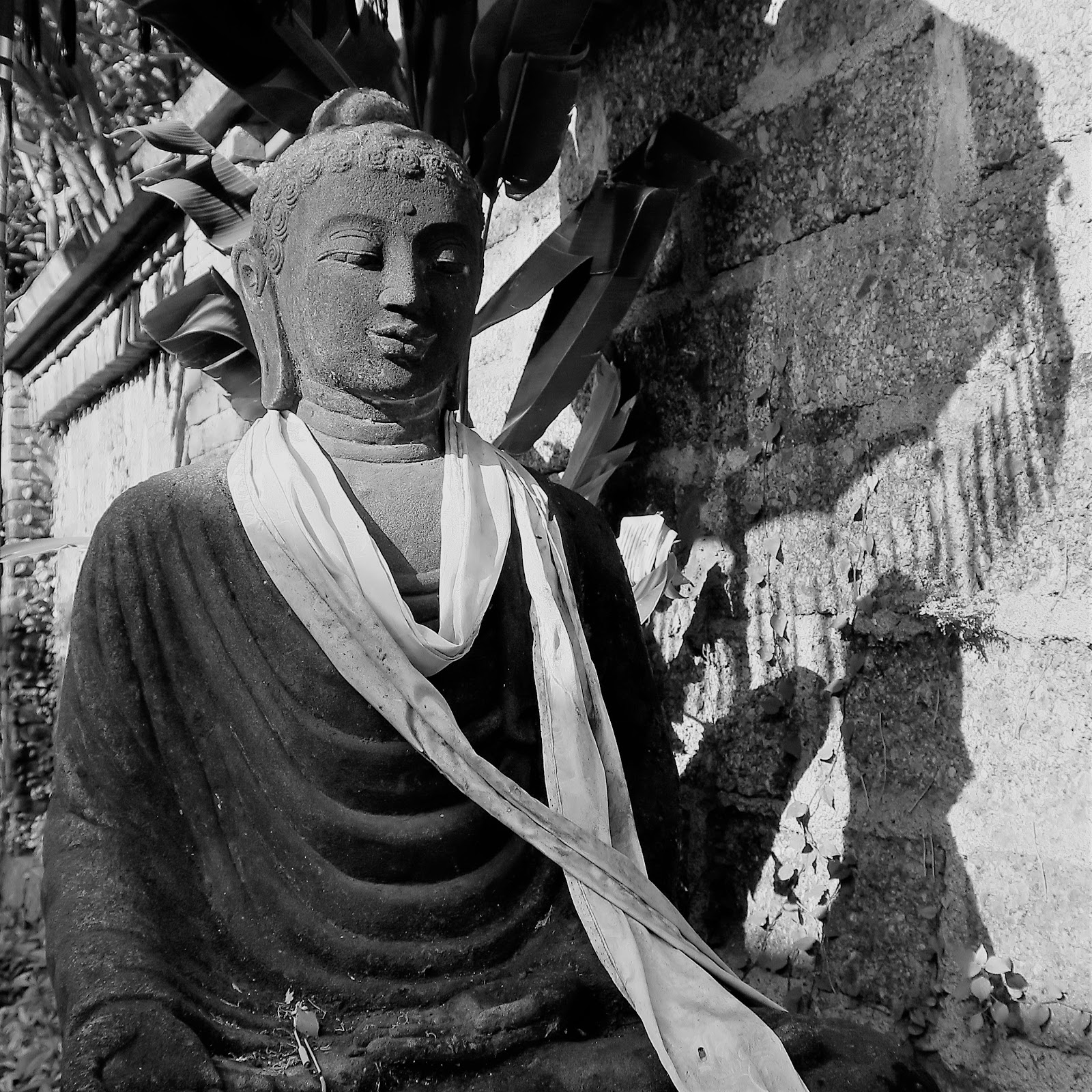
The sign boards at the ends of the street are flanked by stone Buddhas each holding an umbrella in the holy black and white checked fabric that symbolises the balance between good and evil.

The whole street is a bit like that. It is pretty much geared to tourism but seriously supports a lot of local creativity and enterprise.


In the mornings there are fresh offerings carefully placed outside each business. Rice packets, sweets, flowers, incense, and petals. By the end of the day most will be crushed underfoot.
 Family life goes on in the compounds behind decorative brick and stone walls that are green with moss. Each compound has an ornate gate, framing a narrow entrance guarded by statues. Most of these are garlanded or decorated with fabrics and flowers. Many have adopted the homestay concept, but there are still plenty of roosters in the neighborhood. One place has some of the fattest pigeons I have ever seen (is that really chicken in the soto ayam?).


I didn't come to Ubud to shop but if you did, you'd enjoy the variety of small retail businesses that line Jalan Gautama.. From yoga wear to interior design, from local arts and crafts (pottery, carving, painting, weaving, jewelry) to organic skin care products, from feathers to fabrics; there's something for every visitor and the new age vibes are strong.


 Spas, massage, pedicures, facials - it's all here. Many of the homestays also offer lengthy menus of spa options that promise to awaken and relax and restore and rejuvenate.

 If that's not your thing, there are numerous offerings to awaken the senses via the stomach. Some of the best places to eat in Ubud are right here in this street. The Laotian restaurant, Melting Wok, is a favorite. Indonesian food is a bit overshadowed but there are several excellent warung. Tourists have a lot to answer for - pizza, tapas, ice cream, burgers, crepes, sushi for starters, just in this small stretch of Ubud. Or for the yogis, organic, vegan, raw and higher vibe; with piles of cushions and low tables.


The best coffee in Ubud (even if is not actually awakened). Made from a selection of local beans and roasted to perfection on the premises. 

Monday, August 13, 2018

Wayfaring

It's a lovely word, wayfaring. I now wish that is what I had used for this blog instead of Journeying. 

Then again, it too is a cliche. An article in the Guardian about a life-style blogger who makes a living out of travel writing/photography starts 
Henry Miller once famously wrote: “One’s destination is never a place, but rather a new way of looking at things.” 
But the quote actually belongs to Marcel Proust

“My destination is no longer a place, rather a new way of seeing.”