Tuesday, February 12, 2019

An afternoon stroll out of town

At the temple in the main street of Ubud another festival is taking place and the traffic is crazier than usual. Late afternoon, a thunder storm brewing in the distance, and the rice paddies are calling. 


So this is a short stroll along Jalan Kajeng, which leads, as the sign says, to the rice fields. At this end the street is busy with motorbikes.


The street is paved with signed concrete blocks and decorated with inlaid river stones. Lots are signed by individuals, families and businesses, and they mostly date from around 2002. How many of those who contributed still walk over their signatures?


At the start of the street there are the usual businesses - guest houses behind walls with decorated gateways, spas, shops selling arts and crafts, places for cooking classes and painting lessons. 


The base for Ubud Botany Interactive looks a bit derelict, and the Ubud Sari Health resort doesn't look all that well either - but in this climate, moss grows on everything. I'm sure it is lovely once past the entry. 


My favorite shop of this short street is Threads of Life. It is part shop, part gallery, and part textile museum; and they also offer classes and workshops. (These seem to be for groups. Anyone keen on a textile tour?) As well as textiles from different regions of Indonesia, there are examples of traditional basket weaving and other crafts. They support women in the more isolated and remote areas of the islands, encouraging cooperatives that allow them to pursue their traditions and earn an income at the same time, and they help to support highly skilled artisans to pass on and preserve their knowledge. 

After this, my path leaves the street, though unfortunately the passing motorbikes only thin out marginally. 


The path follows the irrigation channels between the fields. Peace descends and the air is fresher. Here and there, fallow fields are being cleared of the water weeds in preparation for the next planting. These fields are a feat of engineering that have endured for centuries and are still managed in the same way as they have been through the decades. Its a cooperative system that is defined by watershed rather than by politics. I'm intrigued by the strength of the walls that define each small field. How did they work out exactly how wide they need to be to maintain strength through wet and dry seasons? 
- a resilient system of bottom-up management that both increases and equalizes harvests (Adaptive self-organisation of Bali's rice fields). 
- in Bali, water is regarded as a public good, the gift of the Goddess of the Lakes.   

Preparing for the women to come and plant the next crop of rice. Some farmers do the job by hand, pulling out armfuls of weeds at a time and sinking them deep into the mud. Others have a machine that does the same thing. 

My destination - a restaurant surrounded by the paddy fields. So what'll it be for early dinner? Check out the meal at the end of this post. Meantime those storm clouds are looking interesting. Utter peacefulness and timelessness.  Distant thunder is the only sound.  


 The expat hunger to live in a villa in the countryside is eating into the arable land, but who wouldn't want to live in a location like this?


Nasi campur with lots of herbs. Organic red rice. Of course - this is Ubud. 

Monday, February 11, 2019

A stroll along 'my' street - Jalan Gautama, Ubud

After a few days in Ubud I'm starting to see more. I'm staying in a homestay in Jalan Gootama. It's a small street which thankfully is closed to cars in the evenings, but busy with scooters and motorbikes all the time. It is a street that rewards a slower perambulation.

This is a very awakened street and I'm blessed to have chosen an awakened place to stay (more on the accommodation at In Da Garden later).

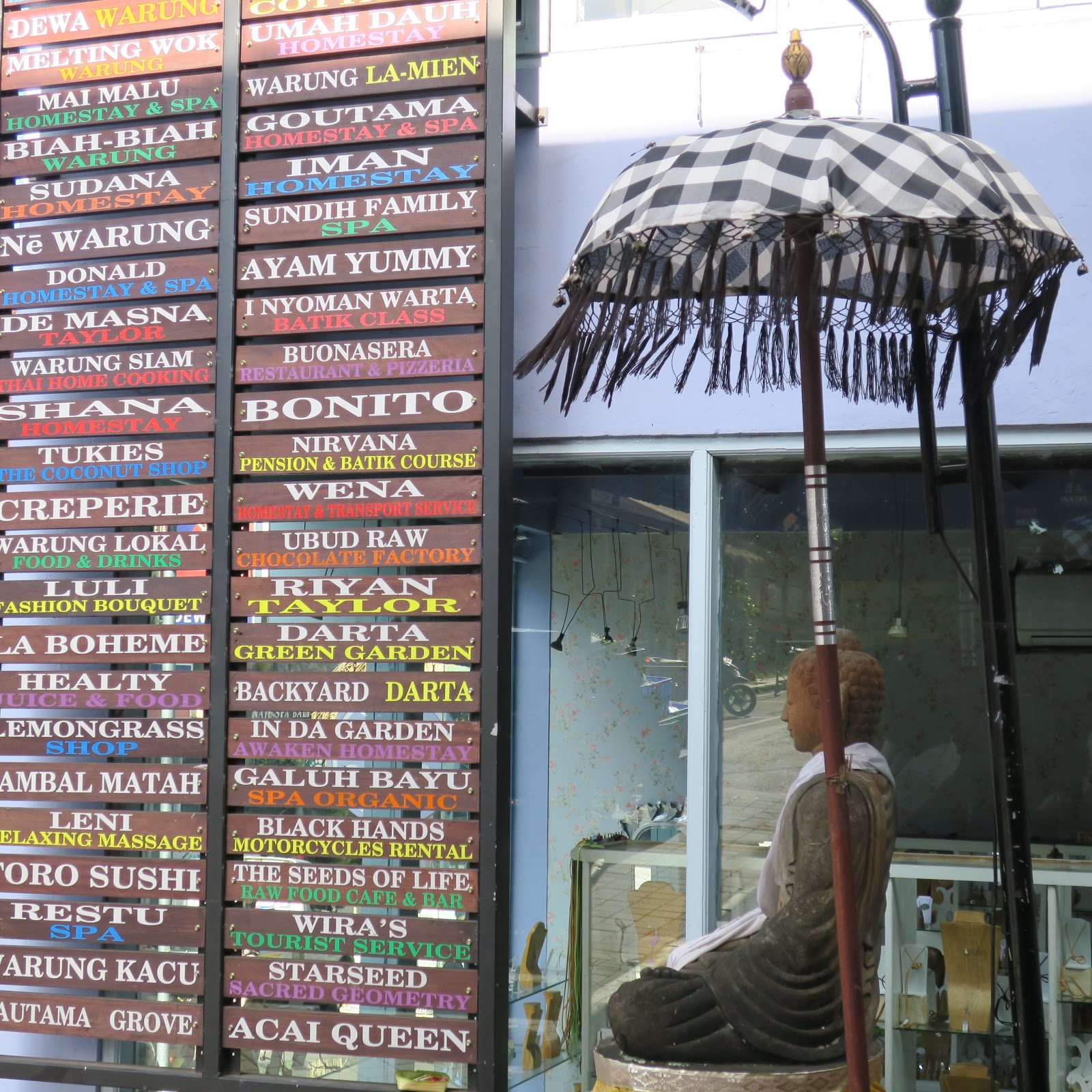
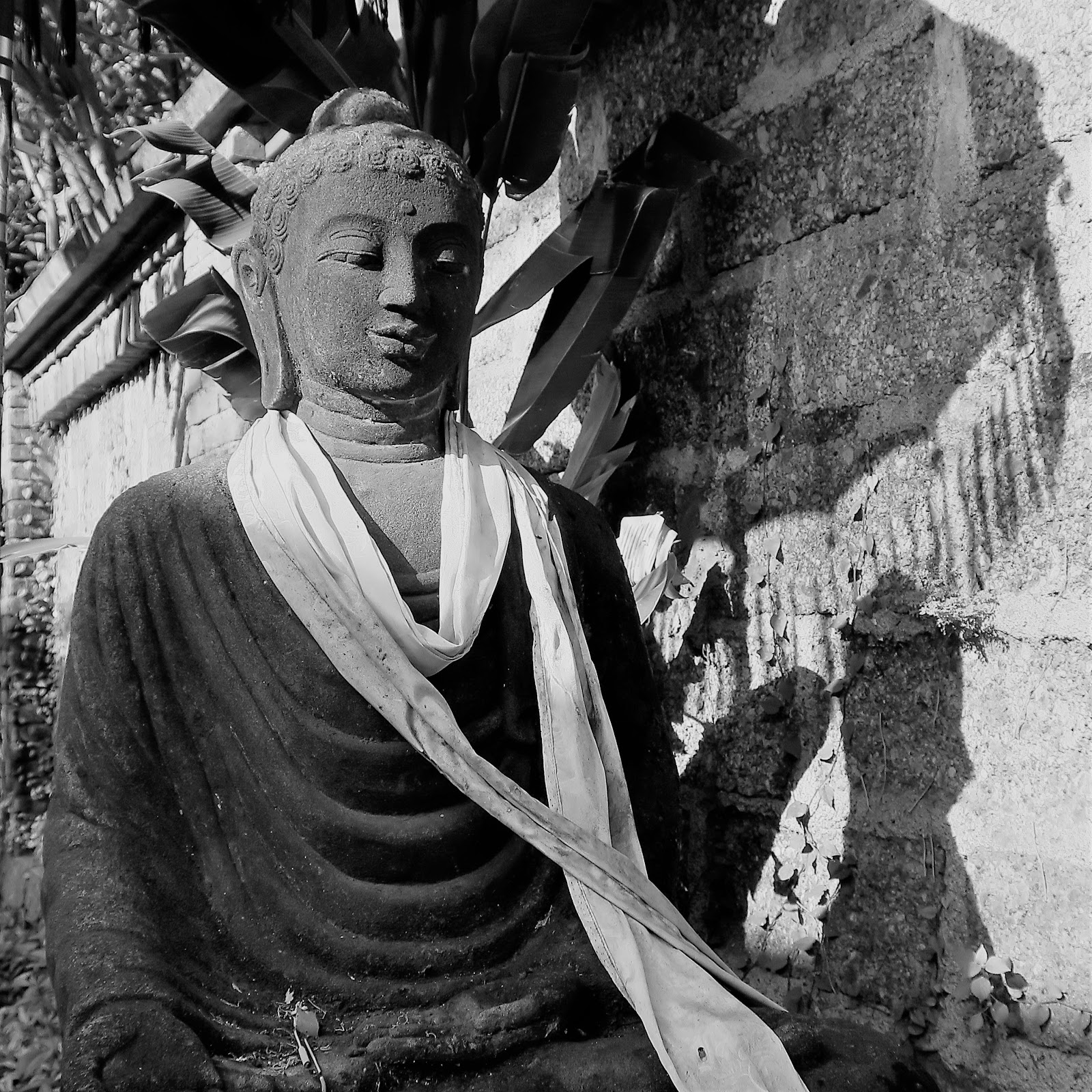
The sign boards at the ends of the street are flanked by stone Buddhas each holding an umbrella in the holy black and white checked fabric that symbolises the balance between good and evil.

The whole street is a bit like that. It is pretty much geared to tourism but seriously supports a lot of local creativity and enterprise.


In the mornings there are fresh offerings carefully placed outside each business. Rice packets, sweets, flowers, incense, and petals. By the end of the day most will be crushed underfoot.
 Family life goes on in the compounds behind decorative brick and stone walls that are green with moss. Each compound has an ornate gate, framing a narrow entrance guarded by statues. Most of these are garlanded or decorated with fabrics and flowers. Many have adopted the homestay concept, but there are still plenty of roosters in the neighborhood. One place has some of the fattest pigeons I have ever seen (is that really chicken in the soto ayam?).


I didn't come to Ubud to shop but if you did, you'd enjoy the variety of small retail businesses that line Jalan Gautama.. From yoga wear to interior design, from local arts and crafts (pottery, carving, painting, weaving, jewelry) to organic skin care products, from feathers to fabrics; there's something for every visitor and the new age vibes are strong.


 Spas, massage, pedicures, facials - it's all here. Many of the homestays also offer lengthy menus of spa options that promise to awaken and relax and restore and rejuvenate.

 If that's not your thing, there are numerous offerings to awaken the senses via the stomach. Some of the best places to eat in Ubud are right here in this street. The Laotian restaurant, Melting Wok, is a favorite. Indonesian food is a bit overshadowed but there are several excellent warung. Tourists have a lot to answer for - pizza, tapas, ice cream, burgers, crepes, sushi for starters, just in this small stretch of Ubud. Or for the yogis, organic, vegan, raw and higher vibe; with piles of cushions and low tables.


The best coffee in Ubud (even if is not actually awakened). Made from a selection of local beans and roasted to perfection on the premises. 

Monday, August 13, 2018

Wayfaring

It's a lovely word, wayfaring. I now wish that is what I had used for this blog instead of Journeying. 

Then again, it too is a cliche. An article in the Guardian about a life-style blogger who makes a living out of travel writing/photography starts 
Henry Miller once famously wrote: “One’s destination is never a place, but rather a new way of looking at things.” 
But the quote actually belongs to Marcel Proust

“My destination is no longer a place, rather a new way of seeing.”


Tuesday, May 2, 2017

A book of migrations: some passages in Ireland

These days my travel is all on screen or page, in the breif evenings after work, usually on the sofa in my Sydney apartment. The title of this post is that of a library book I found while looking for something else (I love that about library shelves of the old-fashioned kind, shelves you can browse. My current library stores most of its collection in a vault with a robotic retrieval system thats away all the fun of random discovery). This is a book by Rebecca Solint, an American who became an Irish citizen in 1986, lived there for ten years, then returned to write a rumination on, as she says, "the ebb and flow of populations that constitutes invasion, exile, colonisation, emigration, tourism and nomadism." And also home, identity, and the "psychic experiment" that is travel itself.

"Here, most often, is nothing more than the best perspective from which to contemplate there", she writes. The quote that opens her book is from Basho 'Every day is a journey, and the journey itself is home.'

Here I am, at home, in a city that has never felt welcoming or knowable, on the trail of my own Irish passport, and contemplating my next round of adventures from the lulling comfort of the sofa.

"Ireland delighted me by offering so many stories and circumstances in which individuals and populations were fluid rather than ossfied," she writes, and I thrill to the idea that perhaps this explains everything, my restlesness and endless yearning to be somewhere else. Maybe I am Irish, too.


Thursday, October 6, 2016

London By Bike

They used to be called Boris Bikes
- before he fell from grace
During the fortnight in London I cycled every day. The cycle paths are fantastic. I had two main ways to get into the city from Herne Hill.

One way followed Route 25 and was mostly a stress-free cruisy ride.

The routes are well-marked with signs as well as road markings.

Council bike lockers 

Burgeoning Battersea - shared bus/bike lane

Historic Chelsea Bridge  -
a whole lane just for bikes

Mud-larking time along the Thames

The other option was to join the north-south Cycle SuperHighway at Brixton and ride hard and fast. Why fast? Long straight stretches with a whole lane reserved for bikes, made for flying along. Except that the lane is shared by buses. And there is nothing scarier than looking up and seeing that a double decker bus has pulled up just ahead of you. Oh wait. Scarier than that is when you sense something breathing down your neck, and realise that one of those buses has snuck up behind you and and is coming alongside, so close that you seem to feel it brush the hairs on your legs.

 Actually I think the scariest thing of all on London roads is the other cyclists. Coming home during rush hour, I'd pull up at the lights in the space in front of all the cars marked for bikes, and by the time the lights changed (I love that they turn orange and then green int he UK) I'd hear a hundred click click clicks as shoes all around me slotted back into cleats and the muscles and mamils (middle-aged men in lycra) would be past me and shooting off into the distance.

Brockwell Park
Route 25 took me across Brockwell Park, along deserted suburban streets and past my favorite bakery and cafe, Gail's; across Clapham Common, down past the sprouting of high-rise apartments in Battersea, and over Chelsea Bridge.


Gail's goodies (him too)

Clapham Common 


From the other route I could either head into the City or over Waterloo Bridge and past The Strand where I used to work to Covent Garden and Soho. In busy Brixton, the marked cycle path goes down the laneway with a memorial mural for that Brixton boy, David Bowie; where there were fresh bouquets of flowers being left every day.

London Design Week 2016

It was Design Week in London and also my last weekend. In the courtyard at the V&A they have installed a robotic building machine that was dynamically constructing a super-light and super-strong structure in response to the movement and flow of people around the courtyard, which also is home to a busy cafe.


Described as a Garden Installation, the experimental Elytra Filament Pavilion (in fine architectural-speak!) is designed to

"explore the impact of emerging robotic technologies on architectural design, engineering and making. Inspired by a lightweight construction principle found in nature, the fibrous structures of the forewing shells of flying beetles known as elytra, the Pavilion will be an undulating canopy of tightly-woven carbon fibre cells created using a novel robotic production process. The Pavilion will grow over the course of the V&A Engineering Season in response to data on structural behaviour and patterns of inhabitation of the Garden that will be captured by real-time sensors in its canopy fibres." 
I wish I could see it now - did it respond to me as I moved around taking photos?

Another 2016 Design Week installation is the Serpentine Pavilion, designed by Bjarke Ingels Group (BIG). The Serpentine Gallery has a tradition of inviting an architect of note to design and build a summer pavilion beside the gallery in the Kensington Gardens. This year BIG created what they call "an unzipped wall that is transformed from straight line to three-dimensional space". During the day it houses a café and free family activities and at night it becomes a performance space.